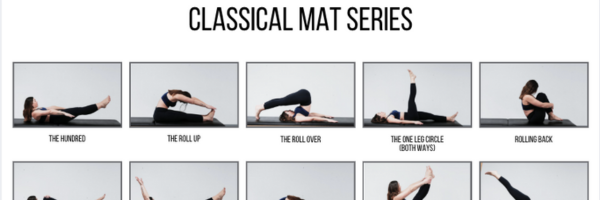

If you’ve ever attended a classical Pilates session and heard your teacher cue “reach your crown to the ceiling while pressing your tailbone to the mat,” you’ve already experienced oppositional movement — even if you didn’t know it by name. It is one of the most elegant and quietly powerful principles in the Pilates method, and once you understand it, your practice will never look quite the same again.
What Is Oppositional Movement?
At its simplest, oppositional movement is the simultaneous reaching of the body in two opposite directions. Rather than collapsing inward or gripping with effort, the body learns to expand — lengthening away from a central point of stability in equal and opposing directions.
Joseph Pilates built this principle into virtually every exercise in his system. It is not a stylistic flourish or a teaching aid for beginners. It is structural. It is what gives classical Pilates its characteristic quality of length, lift, and effortless-looking control.
Think of it like a tug-of-war with yourself — except both sides are pulling equally, so the rope stays perfectly taut and still. That tension, that aliveness in the body, is what we’re cultivating.
The Mechanical Logic Behind the Principle
To understand why opposition works so well, it helps to think about what happens without it.
When we move in only one direction — say, curling the spine forward in a Roll Up — the tendency is to collapse into the movement, using momentum and bulk muscle recruitment to get the job done. The result is usually compression through the spine, gripping in the hip flexors, and a loss of the articulation and control that make Pilates so beneficial.
Introduce opposition — reaching the heels away as the spine curls forward — and something shifts. The body finds length. The spine has a reason to articulate rather than hunch. The deep stabilisers engage, not because you’ve commanded them to, but because the movement itself demands it.
Opposition is, in this way, a form of intelligent loading. It asks the body to organise itself rather than simply comply.
Opposition Through the Classical Repertoire
Let’s look at how this principle manifests across a selection of classical exercises.
The Hundred
One of the first exercises in the classical mat sequence, The Hundred is a masterclass in opposition. The legs reach long and away from the centre — either at tabletop, at a 45- degree angle, or closer to the floor depending on the student’s level — while the head and chest curl forward and up. The abdominals draw in and up. The arms pump with energy but without tension.
The opposition here is multi-directional: legs versus torso, arms driving down versus the spine lengthening up and out of the hips. Without it, the exercise becomes a neck strain and a hip flexor cram. With it, the powerhouse — Pilates’ term for the deep core — has to work meaningfully and continuously.
The Roll Up
Perhaps the most instructive exercise for understanding opposition is the Roll Up. Students frequently struggle to perform it without either flinging themselves up or collapsing on the way down. The cue that changes everything? Reach your feet away from you as you peel your spine off the mat.
The feet reaching forward and the spine reaching upward and over create a controlled opposition that governs the pace and quality of the movement. The body lengthens rather than folds. Spinal articulation — one of the defining goals of classical Pilates — becomes not just possible but inevitable.
The Single Leg Circle
As one leg circles, the opposite hip must remain rooted. The circling leg reaches long from the hip socket — through the knee, through the ankle, through the toes — while the standing leg presses down into the mat and the spine resists any rolling or twisting. The opposition
between the active leg’s reach and the pelvis’s stillness is what makes this a hip mobility exercise rather than a wobbling exercise.
The Swan
In Swan and its preparatory exercises, the opposition between the crown of the head reaching forward and up, and the tailbone lengthening away and down, is what prevents the lumbar spine from crunching under the weight of extension. The back extensors work, but they work in the context of length — not compression. This is the difference between building a healthy back and aggravating one.
The Teaser
The Teaser is often held up as the benchmark of Pilates ability, and rightly so — it demands everything. But it is built entirely on opposition. The legs reach away at their angle, the spine reaches up and forward to meet them, and the arms extend to frame and counterbalance the whole. Remove the opposition, and the Teaser becomes an agonising crunch toward the knees. Maintain it, and the body lifts like a blade of grass, light and rooted at once.
Opposition and the Powerhouse
Oppositional movement is inseparable from Joseph Pilates’ concept of the powerhouse — the cylinder of deep musculature spanning roughly from the base of the ribcage to the hip crease, encompassing the abdominals, the deep back muscles, the pelvic floor, and the diaphragm.
When the body reaches in two directions simultaneously, it must find a stable centre from which to lengthen. That centre is the powerhouse. You cannot truly express opposition without engaging it, which is why teaching through oppositional cues is often far more effective than simply telling a student to “pull their navel in.” The latter is a conscious contraction. The former recruits the powerhouse as a natural consequence of the movement’s architecture.
This is part of what makes classical Pilates so effective for those recovering from injury, for athletes seeking efficiency of movement, and for anyone who wants to move with less effort and more intelligence.
Feeling It in Your Own Body
If you want to experience oppositional movement directly, try this standing exercise before your next session.
Stand tall. Reach the crown of your head toward the ceiling — not by lifting your chin or tensing your shoulders, but by imagining a thread pulling gently upward from the very top of your skull. At the same time, feel your feet press evenly into the floor, your legs rooting downward. Now hold both sensations simultaneously.
Notice how your spine lengthens. Notice how your posture improves without any effortful “correction.” Notice the aliveness in your body — that sense of energised stillness.
That is opposition. That is classical Pilates.
Why It Matters
In a world of fitness fads and high-intensity training, the subtlety of oppositional movement can seem almost counterintuitively gentle. But gentleness and effectiveness are not opposites — and classical Pilates has been proving that for nearly a century.
When you train with opposition as your guide, you stop working against your body and start working through it. Effort becomes efficient. Movement becomes expressive. And the practice, session by session, begins to reach into everyday life — in the way you stand at a kitchen counter, the way you sit at a desk, the way you carry yourself through the world.
At Focus Pilates, classical technique is at the core of everything we do. Whether you’re new to the method or returning to deepen your understanding, we’d love to help you discover what your body is truly capable of.