
If you have practised reformer Pilates in a group setting, or yoga, or any kind of exercise class, your first classical Pilates session will probably feel different from what you expect. This is a guide to what that difference looks like, and why it matters.
It Will Probably Be One-to-One
Classical Pilates, taught properly, begins with individual instruction. Before a student joins a group class — whether on the mat or the apparatus — a skilled classical instructor needs to understand how that student moves: where they are strong, where they compensate, what their spine does, how their hips work, where they hold tension, what history of injury or restriction they carry.
This is not just a safety precaution, though it is partly that. It is the beginning of the teaching relationship that makes classical Pilates effective. The instructor learns the student's body, and the student begins to learn the exercises in a way that is genuinely specific to them — not a general class they are performing alongside, but instruction addressed directly to how they move.
At Focus Pilates, we require a one-to-one session before any new student joins a group class. This is standard in classical studios and worth understanding as the investment it is.
It Will Be Slower Than You Expect
Classical Pilates does not have the pace of a circuit class, or a high-intensity reformer session, or a vinyasa flow. The exercises are performed with attention and control. There are pauses for instruction, for correction, for the student to feel what is being asked of them.
This pace can feel frustrating at first, particularly for students who are accustomed to measuring a session's value by its heart rate. It helps to understand that the nervous system work — the pattern-rewiring, the attention to alignment, the cultivation of genuine core connection — is happening throughout the session and is exhausting in its own way. Many students finish their first classical session feeling tired in ways they did not anticipate from what appeared, from the outside, to be gentle exercise.
You May Be Humbled
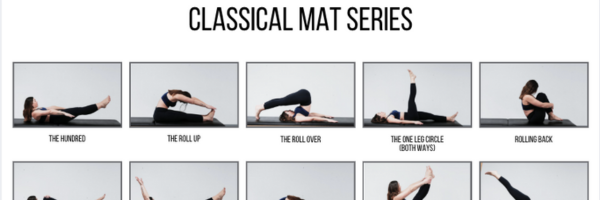
The exercises that look simple are often the hardest. The Roll-Up is a good example — a full spinal articulation from lying to sitting with straight legs, performed with control and without momentum. In principle, straightforward. In practice, it requires abdominal strength, hamstring length, and spinal mobility that many adults, including physically active adults, do not currently have.
This is not a problem. It is information, and a good classical instructor will use it — finding modifications that allow the student to begin working within the sequence immediately, while understanding what needs to develop over time. The first session is always a beginning, not a test.
You Will Learn to Breathe
Whatever else happens in the first session, breathing will come up. The coordination of breath with movement — exhaling on the effort, inhaling to prepare, keeping the breath moving rather than holding it — is foundational to the practice and is something most people need to be taught explicitly.
This is a good thing to be taught. The breath pattern that classical Pilates builds, over time, becomes habitual. Students who practise regularly often find that their relationship to their breath outside the studio changes — that they breathe more fully and more consciously as a consequence of what they have practised on the mat.
It Will Build
The classical method is progressive. Each session builds on the one before. The exercises that felt inaccessible in the first session become familiar; the ones that felt familiar reveal new depth. This is the nature of practising a fixed system over time — the work keeps developing because the body keeps developing.
The most common thing new classical students report after a few months of practice is not that the exercises have become easier, but that they have become more interesting — that they can feel more, understand more, and get more from each session than they could when they started. This is the difference between a class and a practice. Classical Pilates is a practice.