
Classical Pilates is often described by its six guiding principles: breath, concentration, centring, control, precision, and flow. These appear on studio walls, in teacher training manuals, and in almost every introductory text about the method.
They are also, frequently, described in ways that fail to capture what they actually demand. They are presented as qualities to aspire to — an attitude of mindfulness, a general intention to move well. In fact, they are structural features of the practice. They are what the method is built from, and understanding them properly changes how you approach the work.
Breath
Joseph Pilates believed that most people breathe incorrectly — that they do not fully exhale and therefore do not fully inhale, and that this chronic shallowness of breath contributes to the accumulation of carbon dioxide in the body and to the loss of vitality he associated with the unexercised, poorly conditioned modern person.
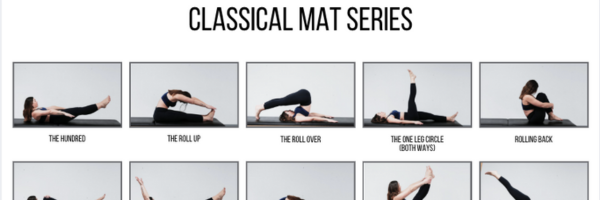
In the classical method, the breath is not an add-on or a relaxation tool. It is coordinated with movement in a specific way — exhaling on the effort, inhaling to prepare, with the full capacity of the lungs engaged. The Hundred, the first exercise in the mat sequence, is explicitly a breathing exercise: five counts in, five counts out, repeated for one hundred beats. The first thing the method teaches you is how to breathe.
This is not incidental. Correct breathing activates the deep core muscles. It moves the ribs, which mobilises the thoracic spine. It creates the rhythm that organises all the work that follows. Without the breath, the exercises are shapes. With the breath, they are movements.
Concentration
Pilates requires genuine mental presence. Not the vague awareness of "mindful movement," but specific, directed attention — to where the body is in space, to how it is organising itself, to the quality of each movement rather than its completion.
This is one of the reasons a Pilates session, done properly, is genuinely tiring in a way that has nothing to do with cardiovascular effort. The nervous system is working. The mind is attending to things it normally leaves to habit. Patterns that have been operating unconsciously for years are being consciously redirected.
Concentration is also why the method produces results. Exercises performed with genuine attention produce different physical adaptations than the same exercises performed while watching television or thinking about something else. The mind-body connection is not metaphorical in Pilates. It is mechanical.
Centring
Joseph Pilates called the deep muscles of the abdomen, lower back, and pelvis the Powerhouse — the centre from which all movement originates and to which all movement returns. Centring, as a principle, means finding and maintaining this engagement throughout the work.
This is not the same as "engaging your core" in the way the phrase is sometimes used — a general bracing or pulling in. Classical centring is more specific: a gathering of the deep abdominals, a connection through the pelvic floor, a sense of the whole centre organising itself as a stable base from which the limbs can move freely.
Centring is what allows the challenging exercises to be performed without strain. When the centre is genuinely engaged, the lumbar spine is supported, the limbs can move with freedom, and the body can work at its full capacity without the compensatory tension that comes from trying to stabilise without the right muscles.
Control
Contrology. The name of the method tells you something about this principle. Control was, for Joseph Pilates, the central quality of good movement — the difference between movement that serves the body and movement that damages it.
In practice, control means that no part of the body moves without intention, that the eccentric (lengthening) phase of every exercise is as considered as the concentric (shortening) phase, and that speed is never used to substitute for strength. A movement performed slowly and with genuine control is harder than the same movement performed quickly. It is also more effective.
Control also means knowing when not to do something. Classical Pilates respects the body's current capacity — it does not ask for a movement the body is not ready for, and it does not reward effort that produces compensation or pain.
Precision
Precision is related to control, but it addresses something more specific: the quality of the movement in space. In classical Pilates, there is a right way to perform each exercise — a specific alignment, a specific range of motion, a specific quality of muscular engagement. Precision means working towards that standard continuously.
This is not perfectionism and it is not rigidity. A beginner performing the Roll-Up with a modified range of motion, working precisely within their current capacity, is being as precise as an advanced practitioner performing the full movement. Precision is relative to where the student is. What it is not is vague.
Flow
The final principle is the most easily misunderstood. Flow does not mean fluid or relaxed or easy. It means that the exercises move continuously into one another, that transitions are part of the practice rather than interruptions of it, and that the session has a quality of unbroken movement from beginning to end.
Flow emerges from the other five principles working together. When the breath is coordinated, the concentration is present, the centre is engaged, the movement is controlled, and the alignment is precise — the work begins to flow as a natural consequence. It cannot be imposed from the outside. It arrives when the other elements are in place.
This is why flow is listed last. Not because it is least important, but because it is what the others make possible.