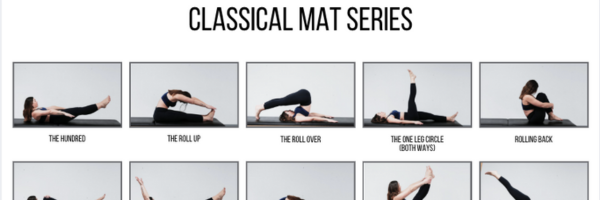

One of the first things a student notices when moving from contemporary to classical
Pilates is that the exercises follow a fixed sequence. This can feel unusual at first — even
restrictive. We are accustomed to the idea that a good instructor adapts the practice to
the student, selects exercises for specific goals, and organises the session around what
feels most needed on a given day.
All of that is true in classical Pilates. But it happens within a structure. And the structure
is not arbitrary — it is one of the most intelligent things about the method.
The Sequence as Architecture
Joseph Pilates designed the thirty-four mat exercises in a specific order for a reason. The
Hundred comes first — a breathing and warming exercise that activates the core, raises
circulation, and prepares the body for what follows. The Roll-Up comes next, asking the
spine to articulate through flexion with the support of the arms. The sequence progresses from there — warming, deepening, challenging, and finally cooling — so that each exercise prepares the body for the one that follows.
This is not the logic of a gym circuit, where exercises are selected for muscle groups and
arranged around recovery. It is the logic of a progression — a sequence designed so that
the body is always ready for the next thing it is asked to do. Remove an exercise from its
place in the sequence and you remove the preparation it provides. Put a challenging
exercise at the beginning before the body is warm and connected, and you get a different
result than if you give it in its proper place.
On the apparatus, the same logic applies. Each piece of apparatus has its own sequence.
The reformer exercises follow a specific order. The Cadillac exercises follow a specific
order. The connections between exercises — in terms of what they prepare, what they
deepen, what they balance — are part of the design.
The Sequence as Diagnostic
A skilled classical instructor uses the sequence as information. When a student struggles
with a particular exercise, the informed response is not to remove it — it is to understand
why the difficulty exists and to use the exercises that precede it to build what is missing.
This is one of the things that distinguishes classical from contemporary teaching.
Contemporary approaches often treat individual exercises as tools to be selected for
specific purposes. Classical teaching treats the sequence as a whole — a system in which everything is connected, and in which difficulty in one place reveals something that needs addressing elsewhere.
The Roll-Over, for instance, requires spinal articulation, hamstring flexibility, and deep
abdominal control. If a student cannot perform it, the classical response is to look at how
they are performing the Roll-Up, the Single Leg Circle, and the exercises that lead up to
it. The problem is almost always visible earlier in the sequence if you know where to look.
The Sequence as Practice
There is also something less analytical and more experiential to be said about following a
fixed sequence.
When you practise the same exercises in the same order consistently over time,
something happens that does not happen in a varied circuit. The body learns the
sequence. The transitions between exercises become part of the practice — not rest
periods, but moments of organisation and preparation. The mind stops planning and
starts attending. The practice develops a quality of flow and presence that is difficult to
achieve when the programme is different every session.
This is not nostalgia or tradition for its own sake. It is the difference between learning a
piece of music by playing it whole, repeatedly, until it is in the body — and selecting a few
bars from different pieces and calling that a practice.
The sequence is the piece. Following it is how you learn it.
Adaptation Within Structure
None of this means the classical method is inflexible. Good classical teaching is
responsive to the student in front of the instructor — to their strength, their history, their
limitations and their capacities on a given day. Exercises can be modified, supported,
prepared for differently. The order can be worked with and around when genuine
contraindication demands it.
But modification within a structure is different from abandoning the structure entirely.
The classical instructor who adapts a session for an injured student is still working within
the logic of the method — thinking about what the body needs, what the sequence
provides, and how to meet the student where they are without losing the coherence of the whole.
This is the skill that comprehensive classical training develops. It takes time, and it
requires a deep familiarity with the sequence itself — knowing not just what each exercise does, but why it is where it is. That knowledge only comes from years of practice, teaching, and study.
At Focus Pilates, we train our instructors in the full classical sequence, on all apparatus,
over six hundred hours. We believe that is the minimum necessary to teach the method
honestly. And we believe the method is worth teaching honestly.